
The History of Notre Dame De Paris
- Jul 23, 2025
- 2 min read
By: Elizabeth Messing
Most people have most likely at least heard the words “Notre Dame,” whether that be the university or the Disney movie, The Hunchback of Notre Dame. Either way, the Notre Dame de Paris cathedral is a famous gothic cathedral from the middle ages.
The gothic style of architecture from the mid-12th century to the 16th century can be found across Europe. Gothic architecture is typically characterized by a high ceiling with walls separated by tracery— stone framework in the head of gothic windows to form ornamental designs. Architects used the rib vault, flying buttress, and pointed arch to combat the challenges of creating a very tall building while using the most natural light possible.
As its title implies, the cathedral is located in Paris, France. In 1160, Maurice de Sully brought the idea of combining the ruins of two prior basilicas. Three years later, Pope Alexander III brought the idea to life, and over the next 200 years, the high altar along with many other areas and embellishments were constructed or added. During the 1800’s, the central spire— a steeply pointed pyramid or cone shaped end to a tower— was added after the original was deemed unstable and completely removed.
Notre-Dame has stood strong through revolutions and world wars, that is until April 15, 2019, when a fire blazed in the cathedral’s attic. The fire originally went off during a Mass at 6:18 PM.
A security employee told a guard to check the attic, but the guard only looked above where the priest was celebrating mass and not above the actual cathedral. By the time they realized there actually was a fire, it had spread through the attic and the lead roof collapsed.
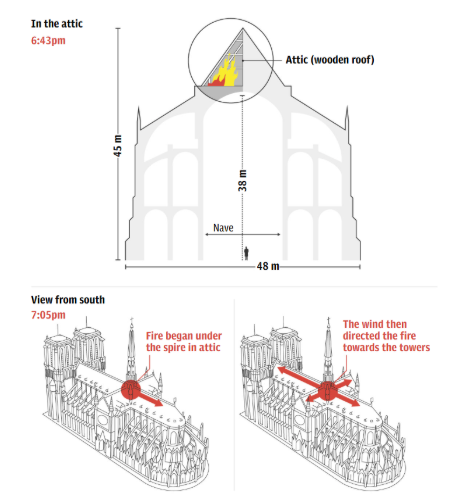
There were many factors that intensified the fire. One of those factors being that the ceiling had no sprinkler system and the fire plan consisted of prevention and detection. Additionally, the wood used in the building was treated with flammable antifungal spray in 2018. According to Jean-Jaques Annaud in the UK edition of The Telegraph, “There were so many mistakes, so many misfunctioning elements. Everything that could go wrong, went wrong.” The diagram above from The Telegraph shows how the fire spread from under the attic beneath the spire to the towers over the course of twenty minutes.
Just after 7pm the night of the fire, the 750 pound spire crashed down and the entirety of the cross-shaped roof was destroyed. Though the roof and spire were destroyed, the grand organ, the three main rose windows, and the Crown of Thorns, believed to have been on the head of Jesus during the crucifixion, were all saved and unharmed by the fire.
Notre-Dame was reopened December 8, 2024, after taking roughly five years to rebuild. The restoration project was monitored by architect Philippe Villneuve and took the work of 2,000 people. Not only were the lead roof and wooden lattice restored to match that of the original design, but also a newly constructed spire to the design of Viollet-le-Duc. Additionally, the organ was cleaned of the lead dust from the collapsed roof and the salt from the water used to put out the fire.
Citations
https://www.britannica.com/technology/fire-prevention-and-control https://www.telegraph.co.uk/films/2022/07/22/everything-could-go-wrong-went-wrong-unbelievable-truth-behind/?ICID=continue_without_subscribing_reg_first

© eugenesergeev—iStock/Getty Images

Credit: Stephane Gautier / Alamy Stock Photo


doesn't Notre Dame mean marry